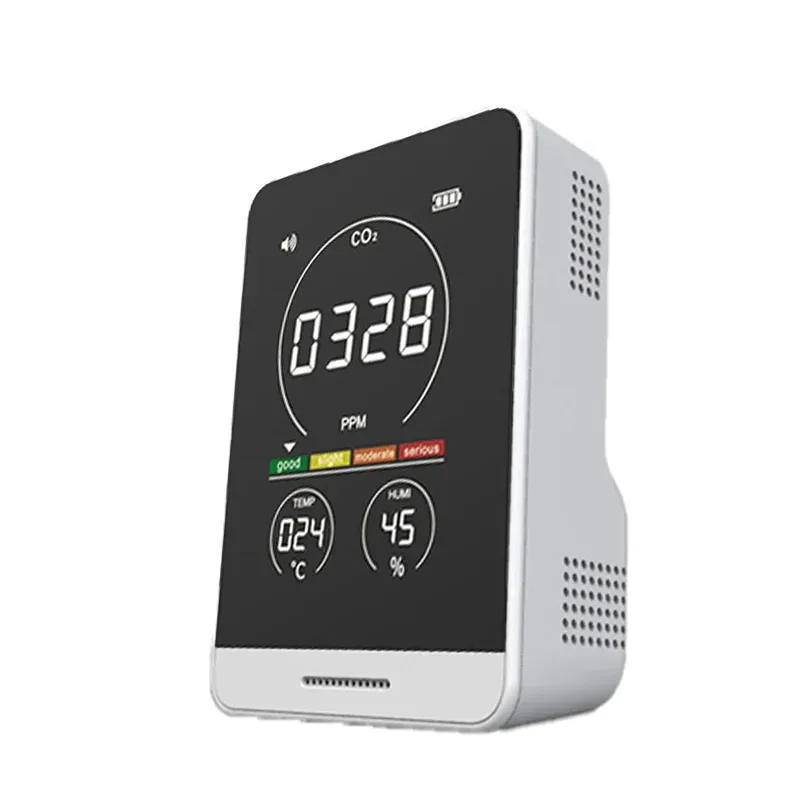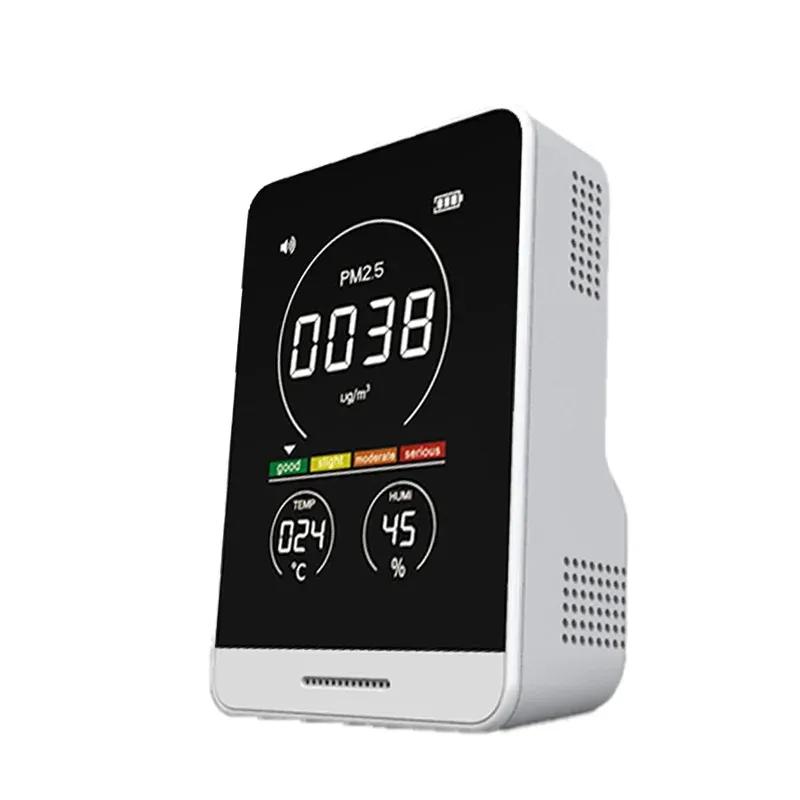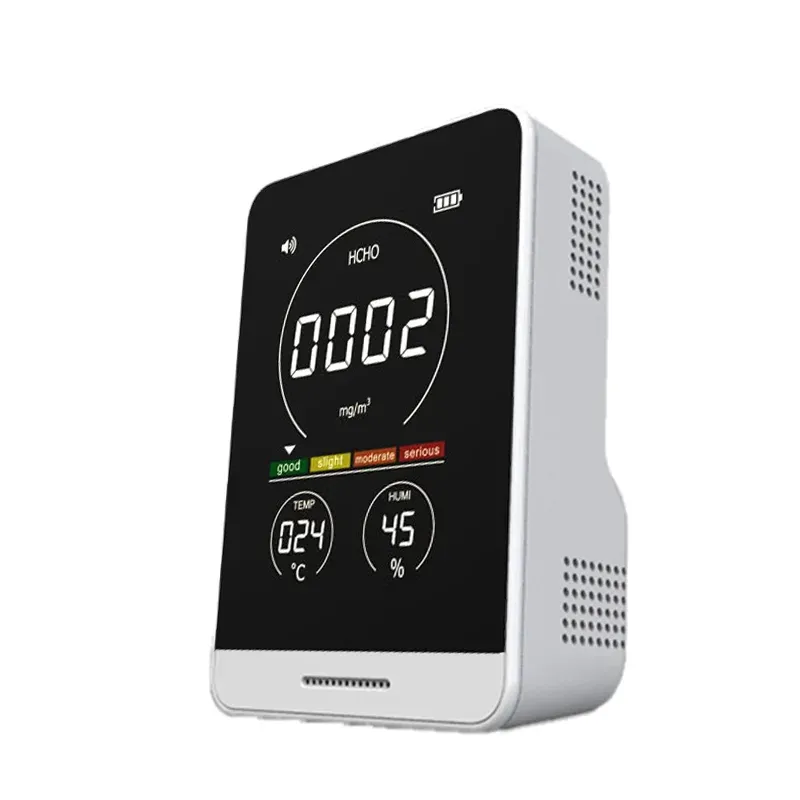


What You Are Actually Measuring
A studio session produces two different problems. People breathing hard push CO2 up quickly, and the reading falls again once the class ends. That is a ventilation question, and it is the one a CO2 channel answers directly.
The second problem is particulate. Chalk, rubber flooring, towel lint and outdoor air drawn in through a street-facing intake all add to PM2.5. A laser particle counting module with a fan-drawn sample path produces a µg/m³ figure worth acting on rather than an inferred estimate.
Formaldehyde matters more than buyers expect in a new or refurbished studio. Boards, adhesives and new furniture off-gas formaldehyde for months after installation, and release rises sharply with both temperature and humidity.
- CO2 for occupancy and ventilation.
- PM2.5 for dust and incoming outdoor air.
Choosing the Sensor Class
The CO2 channel is where most specification mistakes happen. A semiconductor element tracks the rise and fall that tells you to open a window, and that is enough for a room where the only question is whether the air is stale.
Infrared NDIR is the step that turns a trend indicator into a figure you can quote. Infrared measurement does not age the way a semiconductor element does, so a figure taken next winter can be set against one taken today. It is also unaffected by what else is in the air — alcohol, solvents and cooking vapour move a semiconductor CO2 reading, and they do not move an infrared one.
Studios are full of the things that corrupt a semiconductor reading: hand sanitiser at the door, cleaning spray on the mats, and a smoothie bar in the corner. If the number will be shown to members or written into a ventilation assessment, specify the infrared tier.
Matching the Device to the Space
The floor is the first thing to decide. A wall or desk unit suits a fixed studio floor where the monitor stays put and the reading is visible from the doorway. A portable unit suits an operator running several studios, or a trainer checking a spin room, a weights area and a studio in sequence.
Where the monitor is read by members rather than staff, the display layout matters more than the sensor list. A composite index collapses several readings into one figure with a colour scale, so a member or a front-desk assistant knows what to do without knowing what TVOC stands for.
For a studio with a kitchen, a gas hob or an attached plant room, carbon monoxide belongs on the list. An electrochemical CO cell is selective and stable over years rather than months, and CO is colourless and odourless, which is the whole reason it has to be instrumented rather than noticed.
- Member-facing areas: single large reading or a composite index.
Placement and Power
Placement decides whether the numbers mean anything. A CO2 sensor needs to sit in the breathing zone of the room, not on a high shelf or behind a reception screen. A particulate reading follows a door opening, a towel shake or a purifier starting within seconds, which is what makes cause and effect visible to whoever is watching the screen.
Power is the constraint that catches buyers out. Studios rarely have spare sockets at the right height, and a unit that has to be unplugged overnight stops recording overnight. Battery capacity and runtime vary widely across the range, from pocket units with roughly an hour to charge to larger desktop bodies designed to run continuously rather than be picked up and put down.
If the deployment includes night-time monitoring, an auto-dimming display matters. An ambient light sensor drops the backlight as the room darkens, which is the difference between a monitor that stays plugged in and one that gets unplugged.
Data, Alerts and Fleet Management
A single studio can be managed from the screen. A chain cannot. Where a report has to name rooms and times, on-board history is the difference between a finding and a recollection — the device stores its own record, so it logs whether anyone is in the room or not and hands the record over later.
Some configurations extend that to longer trend history, which makes it easier to identify pollution patterns, compare daily changes and adjust ventilation habits. That is the tier to specify when the buyer wants to change how a building is run rather than just watch a number.
Where local regulations require a listed CO alarm, a monitor sits alongside one rather than replacing it.
What to Confirm Before Ordering
Ask for the spec sheet of each model you are considering and read the certification column there, model by model — certifications are shown only on each product spec sheet and are not something to take from a range-level description.
Check the sensor class written against each channel, not just the parameter list. Two units can both say CO2 and behave completely differently in a room full of cleaning products.
Finally, confirm enclosure and carton consistency across the models you plan to stock. Several families in this range share tooling, colour box and carton specification across their tiers, so a mixed pallet ships as a single line item and the accuracy upgrade costs no extra shelf planning.